
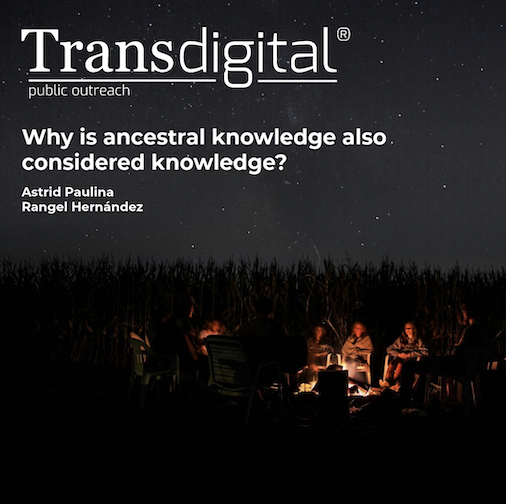
Why is ancestral knowledge also considered knowledge?
Keywords:
knowledge, culture, ancestral knowledgeAbstract
Ancestral knowledge, also known as traditional knowledge, local knowledge, or Indigenous science, is a body of knowledge, innovations, values, attitudes, and practices generated, preserved, and applied by Indigenous and local communities within a specific geographic area. Based on empirical experience acquired over centuries and adapted to the local culture and environment, this knowledge constitutes a fundamental part of the identity, heritage, and worldview of Indigenous peoples.
References
Briones, H. B. E., Muñoz, W. L. C., Patiño, H. M. C., & Moreira, M. F. T. (2021). Saberes ancestrales: una revisión para fomentar el rescate y revalorización en las comunidades indígenas del Ecuador. Journal of Science and Research: Revista Ciencia e Investigación, 6(3), 112-128.
Macas, L. (2005). La necesidad política de una reconstrucción epistémica de los saberes ancestrales. Pueblos indígenas, estado y democracia, 35-42.
Suárez-Guerra, P. (2019). Incorporación de los saberes ancestrales en la educación ordinaria. Revista ciencia UNEMI, 12(30), 130-142.
Villalva, M., & Inga, C. (2021). Saberes ancestrales gastronómicos y turismo cultural de la ciudad de Riobamba, provincia de Chimborazo. Revista Chakiñan de Ciencias Sociales y Humanidades, (13), 129-142.
Downloads
Published
Issue
Section
License
Copyright (c) 2026 Astrid Paulina Rangel Hernández

This work is licensed under a Creative Commons Attribution 4.0 International License.
All articles in Transdigital Public Outreach are licensed under a Creative Commons Attribution 4.0 International License. Authors hold the copyright and retain publishing rights without restrictions.


